
If your hair suddenly feels finer, flatter, drier or simply not quite like it used to, hormonal changes during perimenopause and menopause could be playing a part.
I recently spoke to SheerLuxe about the changes many women notice in their hair during midlife — from increased shedding and reduced density to changes in texture, scalp health and growth.
It’s a subject I feel is particularly important because hair changes can be upsetting, but they shouldn’t automatically be dismissed as “just menopause”. There are several possible causes of hair loss, and understanding what’s actually happening is the first step towards managing it effectively.
Why does hair change during menopause?
Hair is very sensitive to hormonal changes.
As oestrogen and progesterone levels fall during perimenopause and menopause, the hair growth cycle can change. Hair may spend less time in its active growing phase and more time shedding, which can gradually leave it feeling finer and less dense.
But hormones aren’t the whole story.
Genetics, stress, nutrition and your overall health can all influence how your hair responds, which is why the experience varies so much from one woman to another.
Some women notice very little difference; for others, the change can be much more significant.
What are the early signs?
One of the first things you might notice is simply that your hair doesn’t feel the same anymore.
You may see more hair than usual in the shower or on your brush. Your ponytail might feel thinner. Your parting may look wider, or you may become more aware of your scalp.
But it’s not always about hair loss.
During menopause, hair can also become:
- finer or flatter
- drier and rougher
- more prone to frizz
- less elastic
- more susceptible to breakage
- harder to style than it used to be.
During perimenopause these changes can fluctuate as hormone levels change. After menopause, they may become more gradual and persistent.
Is hair loss during menopause normal?
Some daily shedding is completely normal.
What matters more is whether there has been a noticeable change from what’s normal for you.
If you’re suddenly losing considerably more hair, seeing more scalp or noticing that your hair isn’t returning with its previous fullness, I’d recommend seeking professional advice rather than assuming menopause is responsible.
That’s because other issues can present in a very similar way.
Iron or vitamin deficiencies, thyroid disorders, autoimmune conditions and significant stress can all contribute to hair loss. Your GP can help investigate potential underlying causes where appropriate.
Why acting early matters
When it comes to thinning hair, I always favour early assessment over waiting until the change becomes significant.
The appropriate approach depends on why you’re losing hair.
For example, shedding associated with stress, nutritional deficiency or hormonal fluctuations may improve when the underlying issue is addressed.
Female-pattern hair loss is different. In those cases, the aim may be to slow progression, preserve existing hair and support healthier regrowth.
The earlier you understand what’s happening, the more options you potentially have.
Don’t forget about your scalp
We spend a great deal of time thinking about the condition of our hair while overlooking the skin underneath it.
During menopause, changes in natural oil production can leave both the hair and scalp feeling drier.
I like to encourage patients to think of scalp care as an extension of skincare. A clean, healthy scalp provides the environment in which healthy hair needs to grow.
That doesn’t mean throwing every trending scalp product at it.
Gentle cleansing, appropriate scalp care, avoiding excessive heat and chemical damage, managing stress and eating a balanced diet are all sensible foundations.
And don’t be frightened of washing your hair because you’re seeing hairs in the shower. Washing itself doesn’t cause hair loss; it removes hairs that have already completed their natural growth cycle.
Do hair supplements help?
This is another area where marketing can get ahead of the evidence.
Supplements can be useful when there is an actual deficiency, but taking more of something doesn’t automatically result in more hair growth.
Biotin is a good example. It’s frequently promoted for hair growth, but genuine biotin deficiency is relatively uncommon.
Before spending significant amounts on supplements, it’s worth establishing whether there is actually a nutritional deficiency that needs addressing.
What treatments can help menopausal hair loss?
There isn’t one treatment that’s right for every woman, because again, it depends on the cause.
Minoxidil remains one of the established options for female-pattern hair loss and works by helping to extend the hair’s growth phase. Consistency and starting at an appropriate stage are important.
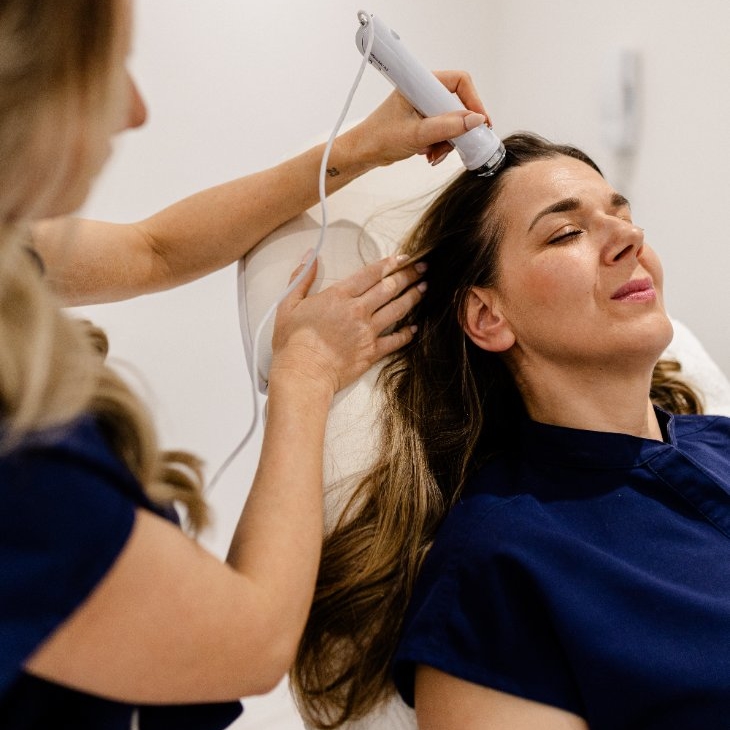
Other approaches are developing too. In my SheerLuxe interview, I discussed LED, PRP and newer regenerative approaches such as exosomes and polynucleotides.
It’s important to keep these in perspective, though. The evidence isn’t equally established for every treatment, and emerging treatments require further robust research.
That’s another reason I’d always advocate assessment first and treatment second.
What about HRT?
Some women notice an improvement in their hair after starting HRT, but HRT isn’t prescribed specifically as a treatment for hair loss, and not everyone will experience a change.
Decisions around HRT should be discussed with an appropriate healthcare professional based on your individual circumstances rather than started purely in response to thinning hair.
The takeaway
Menopause can change the way your hair grows, looks and feels — but you don’t have to simply accept a sudden change without understanding why it’s happening.
Pay attention to what’s normal for your hair.
Look after your scalp, be gentle with increasingly fragile hair, eat a balanced diet and don’t underestimate the effects of stress. Most importantly, seek advice if you notice significant or persistent shedding.
Earlier investigation can help identify the cause and give you more options for managing it.
Caroline Hall featured in SheerLuxe
Caroline Hall, trichologist and founder of R&R Aesthetics, recently contributed her expert advice to SheerLuxe’s “Everything You Need To Know About Menopausal Hair Changes”, alongside hairstylist Sam McKnight.
The feature explores everything from early signs and scalp changes to supplements, HRT and treatments for thinning hair.
Read Caroline’s SheerLuxe feature